
 Purchase this course and get



Structure
Anytime registration
Availability
Complete your course within 5 days
Duration
3 hours
Total Hours
3 hours
Start Date
7 July 2026End Date
31 December 2026
Mode
Self-paced learningWorkshop Introduction
Traumatic stress can shape the brain, body and behaviour in complex ways. This online CPD workshop explores traumatic stress through neurobiology and psychology, helping participants connect evidence-informed insight with clinical practice.
The Neurobiology and Psychology of Traumatic Stress in Clinical Practice workshop offers psychological professionals an evidence-informed exploration of traumatic stress in the South African context.
The workshop examines how single-incident, developmental, relational, and continuous trauma can produce distinct neurobiological and psychological presentations, each with implications for assessment, treatment selection, and sequencing.
Participants will explore continuous traumatic stress, psychological mechanisms, and a mechanism-informed clinical assessment framework designed to help map dominant client processes, prioritise treatment strategies and support evidence-informed treatment planning in practice.
Overview
- Traumatic stress in clinical practice
- The South African traumatic stress context
- Acute Stress Disorder, PTSD and Complex PTSD
- Continuous Traumatic Stress and ongoing threat
- Neurobiology and threat-response systems
- Psychological mechanisms and symptom expression
- Dissociation, emotion dysregulation and cognitive appraisal
- Mechanism-informed clinical assessment
- Treatment selection and sequencing
- Evidence-informed treatment planning
- Adapting trauma-focused approaches for South African practice
- Practice-ready tools and key takeaways
Learning Outcomes
By the end of the workshop, participants will be able to:
- Identify the neural circuits and neuroendocrine systems involved in traumatic stress.
- Explain how threat-response dysregulation shapes traumatic stress symptoms.
- Distinguish between Acute Stress Disorder, PTSD, Complex PTSD and Continuous Traumatic Stress.
- Understand key neurobiological and psychological differences across traumatic stress presentations.
- Explain Continuous Traumatic Stress and its relevance in the South African context.
- Identify mechanisms such as fear conditioning, extinction failure, dissociation and emotion dysregulation.
- Connect traumatic stress mechanisms to evidence-informed treatment strategies.
- Understand the role of stabilisation in trauma-focused clinical intervention.
- Apply a mechanism-informed clinical assessment framework in practice.
- Use assessment insights to support individualised treatment planning and sequencing.
- Adapt trauma-focused approaches for South African clinical and contextual realities.
Learner Experience


Erika Lamprecht


Mpho Ashley Motene


Elizabeth Lucas

Ntshengedzeni Evans Munyai
Certification
This workshop is for you if you want to deepen your understanding of traumatic stress through neurobiology and psychology and translate this insight into more effective, mechanism-informed clinical practice.
Open to anyone with an interest in the topic, this workshop also awards CPD points to eligible professionals upon successful completion.
Bridging neuroscience and clinical practice, the workshop offers applied insight directly relevant to the South African professional context.
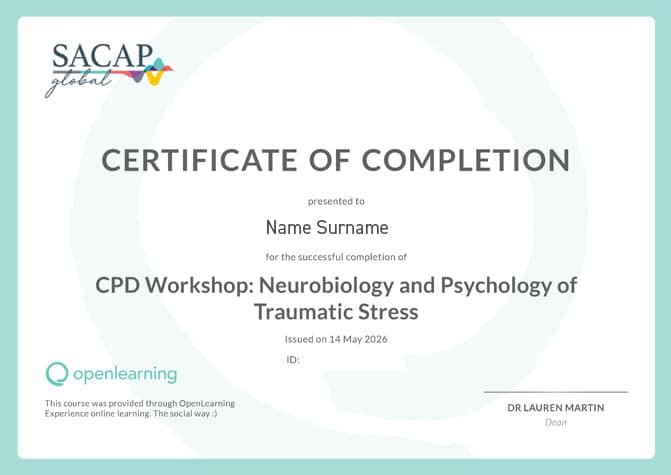
The certificate serves as evidence of your new skills and knowledge and can be used to demonstrate your commitment to professional development.
Attend a live online session, or watch the recording, and complete an online reading and assessment.
HPCSA registered professionals will receive 3 CPD points [3 CEU Continuing Education Units points] upon successful completion of the workshop.
Dates and Registration
Class of 2026: on demand
Participants are required to attend a live online workshop (2 hours). Thereafter, participants will be required to complete an assessment comprising of reading a journal article and answering a 15-question multiple choice questionnaire. The multiple-choice questionnaire needs to be completed within 5 days.
NOTE: HPCSA registered professionals who want to claim 3 CPD points [3 CEU Continuing Education Units points] need to complete the online assessment within 5 days after registering.
Workshop Presenter

Kempie van Rooyen is a registered Clinical Psychologist with nearly two decades of experience in mental health, trauma and psychological assessment; registered with the HPSCSA since 2006. Currently in full-time private practice in Gqeberha, he is widely recognised for his expertise in traumatic stress, gender-based violence, and the intersection of culture and mental health.
Through his work, Kempie continues to bridge research, clinical practice and community engagement, with a particular commitment to improving trauma-informed care and supporting vulnerable populations.
Understand how traumatic stress shapes the brain, body and clinical presentation. Explore PTSD, Complex PTSD and Continuous Traumatic Stress in context. Apply mechanism-informed assessment to guide evidence-informed treatment planning.Course highlights


FAQs
What are the entry requirements?
Anyone 18 years of age or older can sign up for this online workshop. There are no academic entry requirements or conditions.
Who is this workshop for?
This workshop is for anyone interested in understanding traumatic stress through neurobiology and psychology, with particular relevance for mental health professionals.
What is the time commitment?
A total of 3 hours is required to complete the workshop.
What do you need to do the workshop?
- Access to Microsoft Word
- Google Chrome
- Stable internet connection
Is the workshop assessed?
Learners are required to complete an assessment that includes reading a journal article and answering a multiple choice questionnaire.
Is the workshop accredited?
The online workshop is accredited by the Health Professions Council of South Africa (HPCSA).
What is traumatic stress?
Traumatic stress refers to the psychological, emotional and physiological responses that can follow distressing, threatening or overwhelming experiences. It can shape how the brain and body respond to danger, safety, memory and emotion, with important implications for clinical assessment and treatment planning.
The Team
The SACAP Global team brings a wealth of knowledge and practical experience across various disciplines. Our expert short course developers and dedicated support team are passionate about sharing their insights to help you get the most out of your online learning journey.
















Related Courses


Understanding Non-Suicidal Self-Harm
Explore non-suicidal self-injury as a self-regulation strategy and gain practical, trauma-informed tools for assessment and intervention.


Introducing the EmotionAid® Protocol
Learn how to manage stress and trauma using the 5-step EmotionAid® Protocol.

Youth Mental Health First Aid
Explore mental health and gain specific knowledge in suicide and self-harming behaviour in youth.

Understanding Burnout Through the Lens of Compassion
Understand how burnout differs from stress and build practical skills to protect, prevent and manage burnout.

Intro to Crisis & Trauma
Explore various concepts of crisis and trauma and develop a strategy for implementing a trauma-informed approach.

Crisis Interventions
Learn why specific crisis and trauma interventions are appropriate in addressing complex trauma.
R460.00
Start Date
AnytimeEnd Date
31 December 2026-
 Register now. Pay later. 0% Interest.Split into interest free payments.
 -
 Scan to pay.Scan the QR code to pay.
 -

 Credit and debit card.Pay using your credit or debit card.
 -
 Visa Click to Pay.Pay with credit, debit or prepaid card.