
CloseClose Modal

You're almost done!

Remember to navigate back to the website after you've completed the payment. This is the last step to ensure you're successfully registered for your course.

CloseClose Modal

Confirm your email address

Please confirm your email address by typing it in the Confirm email address field.

CloseClose Modal

Thanks for subscribing!

Keep an eye on your inbox as we'll be sharing weekly updates on new courses, discounts and giveaways.

CloseClose Modal

Thanks for subscribing!

Keep an eye on your inbox as we'll be sharing weekly updates on discounts, promotions and giveaways.

Close Close Modal

Thank you for your enquiry!

We've received your request. A member of our team will be in touch soon with more information about the course.

In the meantime, feel free to explore more of our courses.

Online micro-credentials start Monday 18 May 2026

Register
  • Areas of Expertise
  • Full Qualifications
  • Blogs
  • FAQ
  • Gift Voucher

Choose currency

SA flag
R - ZAR
SA flag
R - ZAR
USA flag
$ - USD
  • Browse Courses
    • Applied Psychology icon Applied Psychology dark icon Applied Psychology
    • Counselling icon Counselling dark icon Counselling
    • Business Management & Coaching  icon Business Management & Coaching  dark icon Business Management & Coaching 
    • HR & People Management icon HR & People Management dark icon HR & People Management
    • Communication icon Communication dark icon Communication
    • Everyday Psychology icon Everyday Psychology dark icon Everyday Psychology
    • Future Skills icon Future Skills
    • View All
    • Counselling Children & Youth
    • Social Psychology: How Social Influences Shape Identity
    • Intro to Human Behaviour
    • Factors Influencing Human Behaviour
    • Domains of Psychology
    • Psychological Theories of Child & Adolescent Development
    • VIEW ALL (27)
    • Counselling Children & Youth
    • Fundamental Counselling Skills
    • Deepening Your Counselling Skills
    • Intro to Crisis & Trauma
    • Symptoms of Crisis & Trauma
    • Crisis Interventions
    • VIEW ALL (12)
    • Intro to Organisation Development: Theory & Practice
    • Organisation Development: Processes & Tools for Effectiveness
    • Intro to Management & Leadership
    • Business Management: Global Trends & Organisational Functions
    • Coaching Skills for Managers
    • Intro to Consumer Behaviour & Psychology
    • VIEW ALL (8)
    • Recruiting & Retaining Top Talent
    • Employee Motivation & Wellness
    • VIEW ALL (2)
    • Effective Interpersonal Communication
    • Interpersonal Communication: Relationships & Conflict Management
    • Building Strong Relationships
    • How to Have Critical Conversations
    • VIEW ALL (4)
    • Creative Thinking & Problem Solving
    • Stress Management & Building Resilience
    • Developing Holistic Intelligence: EQ & Beyond
    • Positive Psychology: The Science of Happiness
    • VIEW ALL (4)
    • AI in Education: Ethics & Innovation
    • Intro to Excel: Data Analysis & Visualisation
    • Using AI Tools in Everyday Life
    • Navigating the Impact of AI in the Field of Mental Health
    • VIEW ALL (4)
    • Applied Psychology icon Applied Psychology
      • Counselling Children & Youth
      • Social Psychology: How Social Influences Shape Identity
      • Intro to Human Behaviour
      • Factors Influencing Human Behaviour
      • Domains of Psychology
      • Psychological Theories of Child & Adolescent Development
      • Motivation Mastery: Unlock Potential & Achieve Goals
      • Enhancing Self-Esteem: Tools for Personal Empowerment
      • VIEW ALL (27)
    • Counselling icon Counselling
      • Counselling Children & Youth
      • Fundamental Counselling Skills
      • Deepening Your Counselling Skills
      • Intro to Crisis & Trauma
      • Symptoms of Crisis & Trauma
      • Crisis Interventions
      • Effective Crisis & Trauma Management
      • Addiction Counselling: Beyond Basics
      • VIEW ALL (12)
    • Business Management & Coaching  icon Business Management & Coaching 
      • Intro to Organisation Development: Theory & Practice
      • Organisation Development: Processes & Tools for Effectiveness
      • Intro to Management & Leadership
      • Business Management: Global Trends & Organisational Functions
      • Coaching Skills for Managers
      • Intro to Consumer Behaviour & Psychology
      • Essential Entrepreneurial Skills
      • Intro to Coaching
      • VIEW ALL (8)
    • HR & People Management icon HR & People Management
      • Recruiting & Retaining Top Talent
      • Employee Motivation & Wellness
      • VIEW ALL (2)
    • Communication icon Communication
      • Effective Interpersonal Communication
      • Interpersonal Communication: Relationships & Conflict Management
      • Building Strong Relationships
      • How to Have Critical Conversations
      • VIEW ALL (4)
    • Everyday Psychology icon Everyday Psychology
      • Creative Thinking & Problem Solving
      • Stress Management & Building Resilience
      • Developing Holistic Intelligence: EQ & Beyond
      • Positive Psychology: The Science of Happiness
      • VIEW ALL (4)
    • Future Skills icon Future Skills
      • AI in Education: Ethics & Innovation
      • Intro to Excel: Data Analysis & Visualisation
      • Using AI Tools in Everyday Life
      • Navigating the Impact of AI in the Field of Mental Health
      • VIEW ALL (4)
    • View All Courses
  • Search
  • Promotions
  • About Us
  • My Account
  • My Account
  • Areas of Expertise
  • FAQ
  • Study in South Africa
  • Blogs
  • Choose currency

    SA flag
    R - ZAR
    SA flag
    R - ZAR
    USA flag
    $ - USD
Applied Psychology

Psychological Theories of Child & Adolescent Development

Embark on a journey of discovery and better understand the ways in which children and adolescents think and behave.

R6,470.00

Purchase this course and get 258 Loyalty Points

		Group of young children relaxing on a tennis court
Structure
Set start & end date
Duration
8 weeks
Commitment
10 hours weekly study
Total Hours
80 hours
Start Date
8 June 2026
End Date
2 August 2026
Mode
Mode
Weekly content & tasks
  • Overview
  • What you'll learn
  • Outcomes
  • Testimonials
  • Certification
  • Stackability
  • Dates
  • Highlights
  • FAQs
  • The Team

Course Overview

Embark on a journey of discovery and better understand the ways in which children and adolescents think and behave.

The Psychological Theories of Child and Adolescent Development micro-credential explores the critical milestones that shape how children and adolescents view themselves and others.

In this 8-week course, you will learn about the three stages of early childhood, middle childhood, and adolescence. Explore the development theories of Freud, Erikson, Bowlby, Piaget, Bandura, Vygotsky, Kohlberg, and Maslow.

Learn about relational aspects that impact and influence the behaviour of the adolescent.

What You’ll Learn

Over the course of eight (8) weeks, through videos, readings and discussions, you will explore the following topics:

Week 1: Engage with the developmental theories of Freud, Erikson and Bowlby as they relate to child and adolescent development.

Week 2: Explore the developmental theories of Vygotsky, Bandura, Kohlberg and Maslow as they relate to child and adolescent development.

Week 3: Look at significant developmental milestones of early childhood.

Week 4: Learn about significant developmental milestones of middle childhood.

Week 5: Investigate the physical, cognitive, and moral development aspects of adolescence as well as psychosocial conflicts that occur over this developmental period.

Week 6: Introduction to relational aspects of adolescence that impact and influence the behaviour of the adolescent.

Week 7: Explore a range of contextual factors that impact child and adolescent development.

Week 8: Summative Assessment Case study. Complete and submit a summative assessment in the form of a Case study.

Course Outcomes

By the end of this course you will be able to:

  • Discuss child and adolescent development theories of Freud, Erikson, Bowlby, Piaget, Bandura, Vygotsky, Kohlberg, and Maslow.
  • Explain significant developmental milestones that distinguish early childhood, middle childhood and adolescence.
  • Identify social and emotional/psychological changes which take place across these three developmental stages.
  • Contextualise child and adolescent development through parenting styles and family influences.
  • Describe the significance of Bronfenbrenner’s socio-ecological systems theory for child and adolescent development.

Learner Experience

Tshepang Tsotetsi 

Tshepang Tsotetsi 

"The online course really helped me look at my kids and their behaviour from another perspective. I learnt a lot and enhanced my parenting skills. I also work with children and I feel better equipped to approach and deal with them."
Eveshani Pillay

Eveshani Pillay

"I had a great learning experience! This was my second online course with SACAP Global and I look forward to building new skills and enhancing my knowledge."
Nolusindiso Danga-Kobese

Nolusindiso Danga-Kobese

"The learning experience exceeded my expectations! The short course offered a lot of reading materials to help me recap when I had a chance. I learned a lot."
Anneke Maria Jansen van Vuuren

Anneke Maria Jansen van Vuuren

"My online learning experience was eye-opening. I gained deep insights into theories by Erikson, Piaget, and Vygotsky, and explored how culture, family, and peers influence development. The interactive elements and case studies made complex concepts engaging and practical, enhancing my understanding."
Teagan Rutherford 

Teagan Rutherford 

"This course has been very insightful, offering valuable perspectives on the key psychological frameworks shaping young minds. It has helped me understand how the various developmental stages impact behaviour and growth. I highly recommend this course!"
Natalie Hayes 

Natalie Hayes 

''The learning experience was wonderful and very insightful. The possibility for a deeper understanding of the topic was great.''
Ajida Wailes 

Ajida Wailes 

''I had a great learning experiencing and really enjoyed the course content.''

Certification

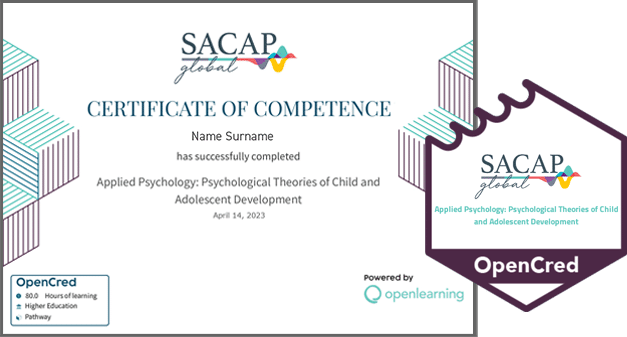
Upon completion, you will receive a digital certificate of competence and badge. Your certificate and badge can be shared on 100+ social media platforms, allowing you to share your achievement with a single click.
Credential Type

The OpenLearning team has reviewed this course to ensure quality academic learning within the Malaysian and Australian credentialing framework.


An OpenLearning OpenCred is a type of credential that can stand-alone, or interact with a formal qualification. OpenCred courses are market-leading online courses that prepare learners for the future of work.


This course has been designed and developed by experts in the field of psychology. The Psychological Theories of Child and Adolescent Development micro-credential is for anyone needing to upskill in this area and offers 80 hours of learning and assessment.


Learners study online with peers and receive robust academic content while acquiring practical industry-relevant skills.

OpenCreds

Completing this course leads to obtaining an OpenCred.

  • 80 hours of learning
  • OpenCred classification: Pathway

Stackable Credentials

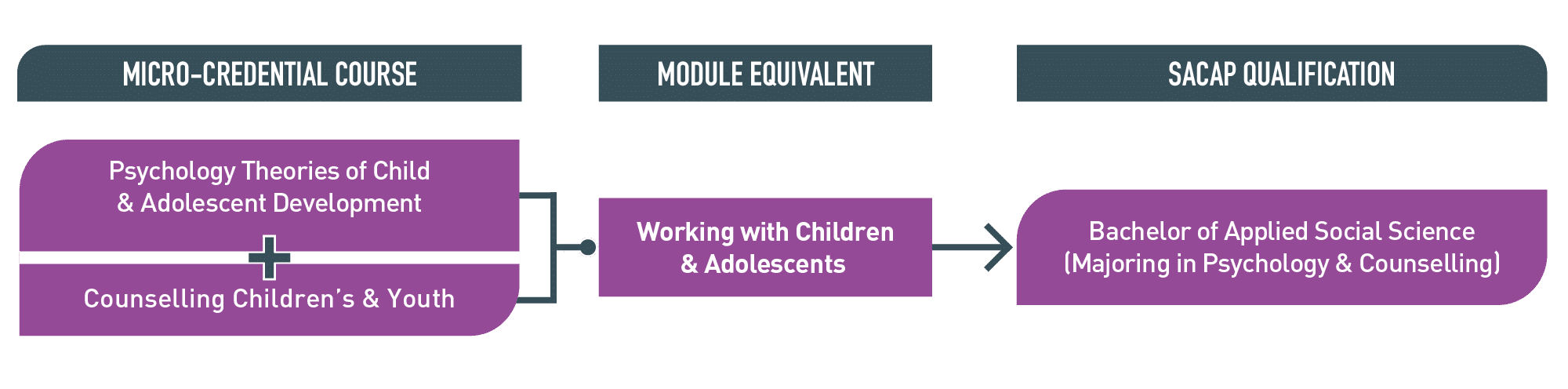
Stack specified combinations of micro-credentials and they can be recognised as equivalent to a module within the Bachelor of Applied Social Science Degree at SACAP. Psychological Theories of Child & Adolescent Development can be stacked with Counselling Children & Youth, and if you meet the minimum entrance criteria, you can enrol for the Bachelor of Applied Social Science Degree and apply for module exemption.
Dates

  • Class of 2026 June: 8 June – 2 August
  • Class of 2026 August: 10 August – 4 October
  • Class of 2026 September: 7 September – 1 November
  • Class of 2026 October: 12 October – 6 December

There are no online classes. Course content is released on a weekly basis allowing you to work through the course material, and meet weekly targets, at a time that is most convenient to you.

Course highlights

young children running around and smiling
  • Evaluate critical developmental milestones in child and adolescent development.

  • Learn about early childhood, middle childhood, and adolescence.

  • Understand core principles that inform the way children and youth think and behave.

FAQs

What are the entry requirements?

Anyone 18 years of age or older can sign up for this micro-credential course. There are no academic entry requirements or conditions. 

Who is this course for?

This course is for anyone interested in understanding the ways that children and adolescents think and behave, and is particularly valuable for parents, teachers, and those who work and engage with children and youth.

What is the time commitment?

A total of 80 hours is required to complete the micro-credential course. An average of 10 hours weekly over 8 weeks. 

What do you need to do the course?
  • Access to Microsoft Word
  • Google Chrome (recommended)
  • Stable internet connection
Is the course accredited?

The micro-credential course is not accredited and non-credit bearing.

What is childhood development?

Early childhood development is a critical window, as it can impact a person’s later development as an adult. While it is never too late to learn, focusing on providing optimal parenting and development can help improve a child’s chances of living a healthy and fulfilling life. Read more here.

The Team

The SACAP Global team brings a wealth of knowledge and practical experience across various disciplines. Our expert short course developers and dedicated support team are passionate about sharing their insights to help you get the most out of your online learning journey.


Gert Lamprecht
Crystal-Shimirhi Bezuidenhoud
Wanga Nemavhola
Kiara Parsuram
Tarien Theron
Carl Badenhorst
Nadia Janssen
Kaylynn Philander
Danica Saunders
Siphesihle Zamane
Tammy-Lee Campher
Stephenie Ramphul
Otto Uys
Ilze Martin
Karolyne Williams
Charlotte Heyn
Stella Madlala
Shanice Thusi

Related Courses

COURSE STARTS 18 MAY 2026
Micro-credential

Counselling Children & Youth

Duration
7 weeks
Price
R5,660.00
Structure
Set start & end date

Develop skills and awareness around current challenges faced by children and youth. 

View course
Add to Cart More Info Class of 2026 May
CPD workshop

Integrating Gestalt Therapy When Working with Children

Duration
3 hours
Price
R460.00
Structure
On-demand

Learn how to use Gestalt Therapy to support children’s emotional well-being and build practical counselling skills.

View course
Add to Cart More Info Class of 2026
TRENDING
CPD workshop

Childhood Disorders: Causes, Symptoms, Misdiagnosis & Psychotherapeutic Treatment Modalities

Duration
3 hours
Price
R460.00
Structure
On-demand

Understand childhood psychological disorders and learn effective approaches for management and treatment.

View course
Add to Cart More Info Class of 2026
TRENDING
CPD workshop

Neurodevelopmental Disorders: Early Diagnosis & Intervention

Duration
3 hours
Price
R460.00
Structure
On-demand

Gain insight into the diagnosis of autism spectrum disorder, attention-deficit/hyperactivity disorder, and dyslexia.

View course
Add to Cart More Info Class of 2026

R6,470.00

or R1617.5 x 4 via PayFlex.
Start Date
8 June 2026
End Date
2 August 2026
Purchase this course and get 258 Loyalty Points

main_courses_subscribe_form

"*" indicates required fields

Get More Information

Yes, I want to receive additional information about Psychological Theories of Child & Adolescent Development. Please contact me:*
Consent; agree to website T&Cs*

  • Register now, pay later with 0% interest via PayFlex
    Register now. Pay later. 0% Interest.
    Split into interest free payments.
  • Scan to pay
    Scan to pay.
    Scan the QR code to pay.
  • Credit and debit card Credit and debit card
    Credit and debit card.
    Pay using your credit or debit card.
  • Visa Click to Pay
    Visa Click to Pay.
    Pay with credit, debit or prepaid card.

Resources
  • FAQs
  • Browse Courses
  • Terms and Conditions
  • Payflex
SACAP Global
  • Areas of Expertise
  • Contact Us
  • About Us
  • About SACAP
VisaMastercardMobicredPayflexSnapScanZapperSamsung PayApple Pay

Copyright © 2026 South African College of Applied Psychology. All Rights Reserved.

Terms and ConditionsPrivacy Policy

  • This field is for validation purposes and should be left unchanged.
  • Subscribe

    Join our community and get 20% off on your first online course

  • By supplying your contact details, you consent to receive communications from SACAP Global and SACAP related to your course of interest and similar topics. You agree to the use of your data as described in our privacy policy and you may opt out of receiving communication at any time.

We use cookies to ensure you get the best possible experience, but please feel free to review our privacy policy or manage your consent.
Cookie Settings

Accept
Manage consent

Privacy Overview

This website uses cookies to improve your experience while you navigate through the website. Out of these, the cookies that are categorized as necessary are stored on your browser as they are essential for the working of basic functionalities of the website. We also use third-party cookies that help us analyze and understand how you use this website. These cookies will be stored in your browser only with your consent. You also have the option to opt-out of these cookies. But opting out of some of these cookies may affect your browsing experience.
Necessary
Always Enabled
Necessary cookies are absolutely essential for the website to function properly. These cookies ensure basic functionalities and security features of the website, anonymously.
CookieDurationDescription
cookielawinfo-checkbox-analytics11 monthsThis cookie is set by GDPR Cookie Consent plugin. The cookie is used to store the user consent for the cookies in the category "Analytics".
cookielawinfo-checkbox-functional11 monthsThe cookie is set by GDPR cookie consent to record the user consent for the cookies in the category "Functional".
cookielawinfo-checkbox-necessary11 monthsThis cookie is set by GDPR Cookie Consent plugin. The cookies is used to store the user consent for the cookies in the category "Necessary".
cookielawinfo-checkbox-others11 monthsThis cookie is set by GDPR Cookie Consent plugin. The cookie is used to store the user consent for the cookies in the category "Other.
cookielawinfo-checkbox-performance11 monthsThis cookie is set by GDPR Cookie Consent plugin. The cookie is used to store the user consent for the cookies in the category "Performance".
customer.io11We use Customer.io to identify users on our website, and offer to send targeted email messages to them. The information housed in the Customer.io database matches the information that you submit to us through forms on the SACAP Global website.
rudderstack11RudderStack allows us to easily build pipelines which connect all our customer data. It pulls analyses from our data warehouse, and triggers enrichment and activation in our customer tools. RudderStack allows us to see the flow of customer data that has been collected throughout all of the cookies used by SACAP Global.
viewed_cookie_policy11 monthsThe cookie is set by the GDPR Cookie Consent plugin and is used to store whether or not user has consented to the use of cookies. It does not store any personal data.
Functional
Functional cookies help to perform certain functionalities like sharing the content of the website on social media platforms, collect feedbacks, and other third-party features.
Analytics and Ads
Analytical cookies are used to understand how visitors interact with the website. These cookies help provide information on metrics the number of visitors, bounce rate, traffic source, etc.
CookieDurationDescription
Google Analytics & Ads11SACAP Global uses Google Analytics to provide statistics and tools for search engine optimisation (SEO) for marketing purposes. Google Analytics is used to track website performance and collect visitor insights. It helps us determine which sources user traffic comes from. It also helps us gauge the success of our marketing activities and campaigns. Google Analytics acquires user data from each website visitor using page tags. A page tag is inserted into the code of each page. This tag runs in the web browser of each visitor, collecting data, and sending it to one of Google’s data collection servers. Google Display Ads rely on cookies and data from users that are signed into the SACAP Global website, to keep track of the websites and searches that you make. These cookies are signals that Google uses to help us reach you.
Social Ads
Advertisement cookies are used to provide visitors with relevant ads and marketing campaigns. These cookies track visitors across websites and collect information to provide customized ads.
CookieDurationDescription
Facebook11The Facebook pixel is a piece of code that is embedded into this website. It collects data that helps us track conversions from Facebook ads. It optimises the ads you see on Facebook, allows us to identify targeted audiences for future ads. The Facebook pixel works by placing and triggering cookies to track users as they interact with the website, both on and off Facebook and Instagram.
SAVE & ACCEPT
Loading...