
 Purchase this course and get



Structure
On-demand
Duration
40 hours
Total Hours
40 hours
Start Date
1 October 2026End Date
31 December 2026
Mode
Self-paced learningCourse Overview
Are you struggling with high-stress environments or burnout? In today’s fast-paced world, stress is inevitable, but how you respond and manage stress makes all the difference.
If you are interested in building resilience and learning how to manage stress in a healthy way, then this is the course for you!
The Stress Management & Building Resilience short course is grounded in psychology and neuroscience and takes an evidence-based approach to practical strategies for stress management and resilience-building.
In this 40-hour short course, you will develop lifelong skills to navigate stress with confidence and resilience by integrating self-reflection, real-world applications, and interactive learning.
Explore the science behind stress, stress triggers and responses, and the effects that stress has on the body and mind. Learn practical techniques to manage stress and enhance resilience.
Topics explored during this short course include emotional regulation, cognitive reframing, mindfulness, self-care strategies, and adaptive coping mechanisms.
This short course will help you develop a resilient mindset that supports long-term success in both personal and professional settings.
What You’ll Learn
Through course videos, readings and discussions, you will explore the following topics:
Understanding Stress and Its Impact
- Physiological and psychological effects of stress on health and cognition.
- The difference between acute and chronic stress.
- Identifying personal stress triggers and current coping mechanisms.
- Recognise signs of burnout and develop strategies for recovery.
The Science of Resilience
- What is resilience and why is it important in stress management?
- Key resilience theories: Psychological Resilience, Grit, Growth Mindset, Post-Traumatic Growth.
- Personal resilience strengths and areas for improvement.
- How to apply resilience-building strategies in various life contexts.
- Integration of physical, psychological, and social self-care strategies into daily life.
- Designing a sustainable self-care routine that promotes resilience.
Emotional Regulation and Mindfulness
- The role of emotional regulation in resilience.
- Habits that promote long-term emotional resilience.
- How to develop emotional intelligence skills to navigate stress and adversity.
- Emotional regulation strategies in real-world scenarios.
- Gratitude techniques to enhance emotional well-being.
- How to use mindfulness and self-awareness to regulate emotions and manage stress.
Building a Resilient Mindset
- How to recognise cognitive distortions and challenge negative thoughts.
- Restructuring of thought patterns.
- Cultivate a growth-oriented mindset.
- Cognitive reframing in stressful situations.
- Problem-solving strategies for handling life’s challenges.
- How to create a personal resilience mantra for long-term mental strength.
Course Outcomes
By the end of this short course you will be able to:
- Understand the physiological and psychological impact of stress.
- Develop self-awareness around stress triggers and coping mechanisms.
- Apply evidence-based resilience-building strategies to real-world challenges.
- Enhance emotional regulation and cognitive flexibility through mindfulness and reframing.
- Build a sustainable, proactive approach to self-care that fosters resilience.
Learner Experience


Laken Jay Smith
Certification
Upon completion, you will receive a digital certificate of completion. This certificate verifies your newfound knowledge and skills.
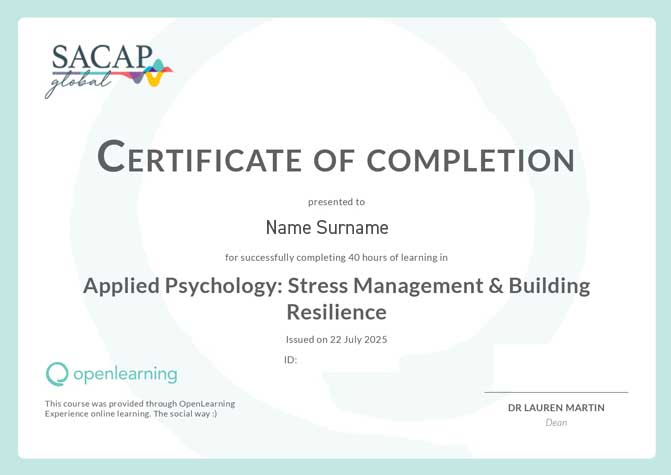
The Stress Management & Building Resilience short course has been designed and developed by experts in the field of psychology and offers +/- 40 hours of learning. The course is for anyone wanting to understand the science of stress and improve their ability to deal with stressful situations and environments.
Dates and Registration
- Class of 2026 Oct-Dec: 1 October – 31 December
- Class of 2027 Jan-Mar: 1 January – 31 March
Short course classes are on demand allowing you to register at any time and move through course content at a time that suits you. Learners will have access to the course for the class period they choose when registering.
Course highlights

-

Understand the physiological and psychological impact of stress.
-
Develop self-awareness around stress triggers and coping mechanisms.
-
Apply evidence-based resilience-building strategies to real-world challenges.
FAQs
What are the entry requirements?
Anyone 18 years of age or older can sign up for this short course. There are no academic entry requirements or conditions.
Who is this short course for?
This short course is for anyone interested in understanding the science of stress and learning how to cope and manage stress better.
What is the time commitment?
A total of 40 hours is required to complete the short course.
What do you need to do the short course?
- Access to Microsoft Word
- Google Chrome (recommended)
- Stable internet connection
Is the short course accredited?
The short course is not accredited and non-credit bearing.
What is stress management?
Stress management is the ability to manage the body’s physiological and psychological responses to stressful situations and adverse circumstances. Read more here.
What is resilience?
Resilience is the skill of adapting, recovering, and thriving in adversity and when faced with challenges. It is not a fixed trait but rather a set of skills and strategies that can be cultivated over time.
The Team
The SACAP Global team brings a wealth of knowledge and practical experience across various disciplines. Our expert short course developers and dedicated support team are passionate about sharing their insights to help you get the most out of your online learning journey.



















Related Courses


Motivation Mastery: Unlock Potential & Achieve Goals
Explore your personal motivation levels and drive, and consider various strategies to enhance them.


Managing & Preventing Anxiety
Build practical tools and knowledge to effectively address and manage anxiety.

Understanding Burnout Through the Lens of Compassion
Understand how burnout differs from stress and build practical skills to protect, prevent and manage burnout.


Developing Holistic Intelligence: EQ & Beyond
Explore dimensions of human intelligence and understand how we think, feel, act and relate to the world.

Domains of Psychology
Understand the biological and neuropsychological functioning of the human mind and body.

Introducing the EmotionAid® Protocol
Learn how to manage stress and trauma using the 5-step EmotionAid® Protocol.
R3,360.00
Start Date
1 October 2026End Date
31 December 2026-
 Register now. Pay later. 0% Interest.Split into interest free payments.
 -
 Scan to pay.Scan the QR code to pay.
 -

 Credit and debit card.Pay using your credit or debit card.
 -
 Visa Click to Pay.Pay with credit, debit or prepaid card.