
CloseClose Modal

You're almost done!

Remember to navigate back to the website after you've completed the payment. This is the last step to ensure you're successfully registered for your course.

CloseClose Modal

Confirm your email address

Please confirm your email address by typing it in the Confirm email address field.

CloseClose Modal

Thanks for subscribing!

Keep an eye on your inbox as we'll be sharing weekly updates on new courses, discounts and giveaways.

CloseClose Modal

Thanks for subscribing!

Keep an eye on your inbox as we'll be sharing weekly updates on discounts, promotions and giveaways.

Close Close Modal

Thank you for your enquiry!

We've received your request. A member of our team will be in touch soon with more information about the course.

In the meantime, feel free to explore more of our courses.

Online micro-credentials start Monday 18 May 2026

Register
  • Areas of Expertise
  • Full Qualifications
  • Blogs
  • FAQ
  • Gift Voucher

Choose currency

SA flag
R - ZAR
SA flag
R - ZAR
USA flag
$ - USD
  • Browse Courses
    • Applied Psychology icon Applied Psychology dark icon Applied Psychology
    • Counselling icon Counselling dark icon Counselling
    • Business Management & Coaching  icon Business Management & Coaching  dark icon Business Management & Coaching 
    • HR & People Management icon HR & People Management dark icon HR & People Management
    • Communication icon Communication dark icon Communication
    • Everyday Psychology icon Everyday Psychology dark icon Everyday Psychology
    • Future Skills icon Future Skills
    • View All
    • Counselling Children & Youth
    • Social Psychology: How Social Influences Shape Identity
    • Intro to Human Behaviour
    • Factors Influencing Human Behaviour
    • Domains of Psychology
    • Psychological Theories of Child & Adolescent Development
    • VIEW ALL (27)
    • Counselling Children & Youth
    • Fundamental Counselling Skills
    • Deepening Your Counselling Skills
    • Intro to Crisis & Trauma
    • Symptoms of Crisis & Trauma
    • Crisis Interventions
    • VIEW ALL (12)
    • Intro to Organisation Development: Theory & Practice
    • Organisation Development: Processes & Tools for Effectiveness
    • Intro to Management & Leadership
    • Business Management: Global Trends & Organisational Functions
    • Coaching Skills for Managers
    • Intro to Consumer Behaviour & Psychology
    • VIEW ALL (8)
    • Recruiting & Retaining Top Talent
    • Employee Motivation & Wellness
    • VIEW ALL (2)
    • Effective Interpersonal Communication
    • Interpersonal Communication: Relationships & Conflict Management
    • Building Strong Relationships
    • How to Have Critical Conversations
    • VIEW ALL (4)
    • Creative Thinking & Problem Solving
    • Stress Management & Building Resilience
    • Developing Holistic Intelligence: EQ & Beyond
    • Positive Psychology: The Science of Happiness
    • VIEW ALL (4)
    • AI in Education: Ethics & Innovation
    • Intro to Excel: Data Analysis & Visualisation
    • Using AI Tools in Everyday Life
    • Navigating the Impact of AI in the Field of Mental Health
    • VIEW ALL (4)
    • Applied Psychology icon Applied Psychology
      • Counselling Children & Youth
      • Social Psychology: How Social Influences Shape Identity
      • Intro to Human Behaviour
      • Factors Influencing Human Behaviour
      • Domains of Psychology
      • Psychological Theories of Child & Adolescent Development
      • Motivation Mastery: Unlock Potential & Achieve Goals
      • Enhancing Self-Esteem: Tools for Personal Empowerment
      • VIEW ALL (27)
    • Counselling icon Counselling
      • Counselling Children & Youth
      • Fundamental Counselling Skills
      • Deepening Your Counselling Skills
      • Intro to Crisis & Trauma
      • Symptoms of Crisis & Trauma
      • Crisis Interventions
      • Effective Crisis & Trauma Management
      • Addiction Counselling: Beyond Basics
      • VIEW ALL (12)
    • Business Management & Coaching  icon Business Management & Coaching 
      • Intro to Organisation Development: Theory & Practice
      • Organisation Development: Processes & Tools for Effectiveness
      • Intro to Management & Leadership
      • Business Management: Global Trends & Organisational Functions
      • Coaching Skills for Managers
      • Intro to Consumer Behaviour & Psychology
      • Essential Entrepreneurial Skills
      • Intro to Coaching
      • VIEW ALL (8)
    • HR & People Management icon HR & People Management
      • Recruiting & Retaining Top Talent
      • Employee Motivation & Wellness
      • VIEW ALL (2)
    • Communication icon Communication
      • Effective Interpersonal Communication
      • Interpersonal Communication: Relationships & Conflict Management
      • Building Strong Relationships
      • How to Have Critical Conversations
      • VIEW ALL (4)
    • Everyday Psychology icon Everyday Psychology
      • Creative Thinking & Problem Solving
      • Stress Management & Building Resilience
      • Developing Holistic Intelligence: EQ & Beyond
      • Positive Psychology: The Science of Happiness
      • VIEW ALL (4)
    • Future Skills icon Future Skills
      • AI in Education: Ethics & Innovation
      • Intro to Excel: Data Analysis & Visualisation
      • Using AI Tools in Everyday Life
      • Navigating the Impact of AI in the Field of Mental Health
      • VIEW ALL (4)
    • View All Courses
  • Search
  • Promotions
  • About Us
  • My Account
  • My Account
  • 1
  • Areas of Expertise
  • FAQ
  • Study in South Africa
  • Blogs
  • Choose currency

    SA flag
    R - ZAR
    SA flag
    R - ZAR
    USA flag
    $ - USD
Applied Psychology

Understanding Non-Suicidal Self-Harm

Explore non-suicidal self-injury as a self-regulation strategy and gain practical, trauma-informed tools for assessment and intervention.

R460.00

Purchase this course and get 18 Loyalty Points

		selfharm
Structure
On-demand
Duration
2 hours
Total Hours
2 hours
Start Date
2 April 2026
End Date
31 December 2026
Mode
Mode
Self-paced learning
  • Introduction
  • Overview
  • Outcomes
  • Certification
  • Dates
  • Presenter
  • Highlights
  • FAQs
  • The Team

Workshop Introduction

Self-harm, also known as non-suicidal self-injury (NSSI), is the deliberate act of injuring one’s body, often as a way to cope with intense emotional pain such as sadness, anger, or stress. Self-harm is a sign of underlying emotional distress or an associated mental health condition.

The Understanding Non-Suicidal Self-Harm workshop offers mental health professionals a practical, trauma-informed approach to understanding and treating self-harm.

The workshop covers the DSM-5-TR, neurobiology, and a self-regulation model and looks at why individuals engage in non-suicidal self-injury (NSSI) and how to clearly distinguish it from suicidal behaviour.

Participants will learn how to conduct assessments, create trauma-informed case formulations, and use intervention strategies in their clinical work.

The workshop ends by looking into risk management, ethical aspects, and socio-cultural factors relevant to NSSI in the South African context. It equips mental health practitioners with tools they can apply right away in therapy.

Overview

  • Understanding non-suicidal self-injury (NSSI)
  • Non-suicidal self-injury (NSSI) in the DSM-5 TR
  • Non-suicidal self-injury (NSSI) as Self-Regulation
  • Neurological Pathways
  • Demographics & South African Context
  • Assessment & Formulation
  • Intervention Strategies
  • Ethical & Professional Considerations
  • Resources and Key Takeaways

Learning Outcomes

By the end of the workshop, participants will be able to:

  • Clearly define non-suicidal self-injury (NSSI).
  • Understand how non-suicidal self-injury (NSSI) is classified in the DSM-5-TR.
  • Conceptualise non-suicidal self-injury (NSSI) through a self-regulation lens.
  • Describe the neurological processes involved in non-suicidal self-injury (NSSI).
  • Recognise how trauma, developmental factors, and socio-cultural influences.
  • Conduct function-focused, trauma-informed assessments and develop clear case formulations.
  • Apply best-practice clinical thinking.
  • Implement practical, evidence-informed intervention strategies in therapeutic settings.
  • Navigate ethical and professional considerations related to non-suicidal self-injury (NSSI).
  • Use practical tools such as the NSSI Regulation Mapping Worksheet to support clinical work.

Certification

This CPD workshop has been designed for psychologists, mental health practitioners and anyone interested in gaining knowledge in non-suicidal self-injury (NSSI).
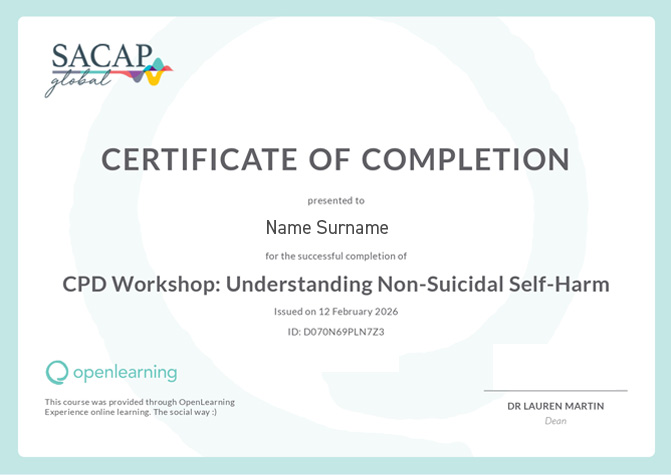
The certificate serves as evidence of your new skills and knowledge and can be used to demonstrate your commitment to professional development. 

Attend a live online session, or watch the recording, and complete an online reading and assessment. 

HPCSA registered professionals will receive 3 CPD points [3 CEU Continuing Education Units points] upon successful completion of the workshop.

Dates and Registration

Class of 2026: on demand

Participants can register at any time and move through the workshop content. Watch the live workshop recording and complete the online journal articles and multiple-choice questionnaire.

NOTE: HPCSA registered professionals who want to claim 3 CPD points [3 CEU Continuing Education Units points] need to complete the online assessment within 5 days after registering.

Workshop Presenter

Anita Kriel is a Clinical Psychologist by profession. She has dual master’s degrees in clinical psychology and research psychology, and has published in local and international journals. Anita spent over 20 years in private practice and, in 2023, took on a full-time position at SACAP as an Educator.

Course highlights

Self-harm image of girl in dark room
  • Understand non-suicidal self-injury (NSSI) as a self-regulation strategy.

  • Explore practical, trauma-informed assessment and intervention tools.

  • Apply theory to real clinical practice within the South African context.

FAQs

What are the entry requirements?

Anyone 18 years of age or older can sign up for this online workshop. There are no academic entry requirements or conditions.

Who is this workshop for?

This workshop will help you gain a better understanding of non-suicidal self-injury (NSSI).

What is the time commitment?

A total of 2 hours is required to complete the workshop. 

What do you need to do the workshop?
  • Access to Microsoft Word
  • Google Chrome
  • Stable internet connection

Is the workshop assessed?

Learners are required to complete an assessment that includes reading a journal article and answering a multiple choice questionnaire.

Is the workshop accredited?

The online workshop is pending accreditation from the Health Professions Council of South Africa (HPCSA).

What is self-harm? 

Self-harm is also known as non-suicidal self-injury disorder. Often, it’s just called self-injury. Self-harm is the act of purposely injuring one’s body as an attempt to cope with emotional pain, for example sadness, anger and stress. Read more here.

What can you do after completing this workshop?

HPCSA registered professionals will receive 3 CPD points [3 CEU Continuing Education Units points] once they complete the workshop.

The Team

The SACAP Global team brings a wealth of knowledge and practical experience across various disciplines. Our expert short course developers and dedicated support team are passionate about sharing their insights to help you get the most out of your online learning journey.


Gert Lamprecht
Crystal-Shimirhi Bezuidenhoud
Wanga Nemavhola
Kiara Parsuram
Tarien Theron
Carl Badenhorst
Nadia Janssen
Kaylynn Philander
Danica Saunders
Siphesihle Zamane
Tammy-Lee Campher
Stephenie Ramphul
Otto Uys
Ilze Martin
Karolyne Williams
Charlotte Heyn
Stella Madlala
Shanice Thusi

Related Courses

Short course

Holistic Approach to Managing Depression

Duration
50 hours
Price
R3,700.00
Structure
On-demand

Explore the intricate landscape of depression and learn how to effectively address and manage depression.


View course
Add to Cart More Info Class of 2026 Apr-Jun
Short course

Managing & Preventing Anxiety

Duration
50 hours
Price
R3,700.00
Structure
On-demand

Build practical tools and knowledge to effectively address and manage anxiety.    

View course
Add to Cart More Info Class of 2026 Apr-Jun
CPD workshop

Youth Mental Health First Aid

Duration
3 hours
Price
R460.00
Structure
On-demand

Explore mental health and gain specific knowledge in suicide and self-harming behaviour in youth.

View course
Add to Cart More Info Class of 2026
COURSE STARTS 18 MAY 2026
Micro-credential

Symptoms of Crisis & Trauma

Duration
2 weeks
Price
R1,650.00
Structure
Set start & end date

Explore immediate and long-term effects of crisis and trauma and accompanying emotional and physical reactions.

View course
Add to Cart More Info Class of 2026 May

R460.00

or R115 x 4 via PayFlex.
Start Date
2 April 2026
End Date
31 December 2026
Purchase this course and get 18 Loyalty Points

main_courses_subscribe_form

"*" indicates required fields

Get More Information

Yes, I want to receive additional information about Understanding Non-Suicidal Self-Harm. Please contact me:*
Consent; agree to website T&Cs*

  • Register now, pay later with 0% interest via PayFlex
    Register now. Pay later. 0% Interest.
    Split into interest free payments.
  • Scan to pay
    Scan to pay.
    Scan the QR code to pay.
  • Credit and debit card Credit and debit card
    Credit and debit card.
    Pay using your credit or debit card.
  • Visa Click to Pay
    Visa Click to Pay.
    Pay with credit, debit or prepaid card.

Resources
  • FAQs
  • Browse Courses
  • Terms and Conditions
  • Payflex
SACAP Global
  • Areas of Expertise
  • Contact Us
  • About Us
  • About SACAP
VisaMastercardMobicredPayflexSnapScanZapperSamsung PayApple Pay

Copyright © 2026 South African College of Applied Psychology. All Rights Reserved.

Terms and ConditionsPrivacy Policy

  • This field is for validation purposes and should be left unchanged.
  • Subscribe

    Join our community and get 20% off on your first online course

  • By supplying your contact details, you consent to receive communications from SACAP Global and SACAP related to your course of interest and similar topics. You agree to the use of your data as described in our privacy policy and you may opt out of receiving communication at any time.

We use cookies to ensure you get the best possible experience, but please feel free to review our privacy policy or manage your consent.
Cookie Settings

Accept
Manage consent

Privacy Overview

This website uses cookies to improve your experience while you navigate through the website. Out of these, the cookies that are categorized as necessary are stored on your browser as they are essential for the working of basic functionalities of the website. We also use third-party cookies that help us analyze and understand how you use this website. These cookies will be stored in your browser only with your consent. You also have the option to opt-out of these cookies. But opting out of some of these cookies may affect your browsing experience.
Necessary
Always Enabled
Necessary cookies are absolutely essential for the website to function properly. These cookies ensure basic functionalities and security features of the website, anonymously.
CookieDurationDescription
cookielawinfo-checkbox-analytics11 monthsThis cookie is set by GDPR Cookie Consent plugin. The cookie is used to store the user consent for the cookies in the category "Analytics".
cookielawinfo-checkbox-functional11 monthsThe cookie is set by GDPR cookie consent to record the user consent for the cookies in the category "Functional".
cookielawinfo-checkbox-necessary11 monthsThis cookie is set by GDPR Cookie Consent plugin. The cookies is used to store the user consent for the cookies in the category "Necessary".
cookielawinfo-checkbox-others11 monthsThis cookie is set by GDPR Cookie Consent plugin. The cookie is used to store the user consent for the cookies in the category "Other.
cookielawinfo-checkbox-performance11 monthsThis cookie is set by GDPR Cookie Consent plugin. The cookie is used to store the user consent for the cookies in the category "Performance".
customer.io11We use Customer.io to identify users on our website, and offer to send targeted email messages to them. The information housed in the Customer.io database matches the information that you submit to us through forms on the SACAP Global website.
rudderstack11RudderStack allows us to easily build pipelines which connect all our customer data. It pulls analyses from our data warehouse, and triggers enrichment and activation in our customer tools. RudderStack allows us to see the flow of customer data that has been collected throughout all of the cookies used by SACAP Global.
viewed_cookie_policy11 monthsThe cookie is set by the GDPR Cookie Consent plugin and is used to store whether or not user has consented to the use of cookies. It does not store any personal data.
Functional
Functional cookies help to perform certain functionalities like sharing the content of the website on social media platforms, collect feedbacks, and other third-party features.
Analytics and Ads
Analytical cookies are used to understand how visitors interact with the website. These cookies help provide information on metrics the number of visitors, bounce rate, traffic source, etc.
CookieDurationDescription
Google Analytics & Ads11SACAP Global uses Google Analytics to provide statistics and tools for search engine optimisation (SEO) for marketing purposes. Google Analytics is used to track website performance and collect visitor insights. It helps us determine which sources user traffic comes from. It also helps us gauge the success of our marketing activities and campaigns. Google Analytics acquires user data from each website visitor using page tags. A page tag is inserted into the code of each page. This tag runs in the web browser of each visitor, collecting data, and sending it to one of Google’s data collection servers. Google Display Ads rely on cookies and data from users that are signed into the SACAP Global website, to keep track of the websites and searches that you make. These cookies are signals that Google uses to help us reach you.
Social Ads
Advertisement cookies are used to provide visitors with relevant ads and marketing campaigns. These cookies track visitors across websites and collect information to provide customized ads.
CookieDurationDescription
Facebook11The Facebook pixel is a piece of code that is embedded into this website. It collects data that helps us track conversions from Facebook ads. It optimises the ads you see on Facebook, allows us to identify targeted audiences for future ads. The Facebook pixel works by placing and triggering cookies to track users as they interact with the website, both on and off Facebook and Instagram.
SAVE & ACCEPT
Loading...