
 Purchase this course and get



Structure
On-demand
Duration
2 hours
Total Hours
2 hours
Start Date
2 April 2026End Date
31 December 2026
Mode
Self-paced learningWorkshop Introduction
Self-harm, also known as non-suicidal self-injury (NSSI), is the deliberate act of injuring one’s body, often as a way to cope with intense emotional pain such as sadness, anger, or stress. Self-harm is a sign of underlying emotional distress or an associated mental health condition.
The Understanding Non-Suicidal Self-Harm workshop offers mental health professionals a practical, trauma-informed approach to understanding and treating self-harm.
The workshop covers the DSM-5-TR, neurobiology, and a self-regulation model and looks at why individuals engage in non-suicidal self-injury (NSSI) and how to clearly distinguish it from suicidal behaviour.
Participants will learn how to conduct assessments, create trauma-informed case formulations, and use intervention strategies in their clinical work.
The workshop ends by looking into risk management, ethical aspects, and socio-cultural factors relevant to NSSI in the South African context. It equips mental health practitioners with tools they can apply right away in therapy.
Overview
- Understanding non-suicidal self-injury (NSSI)
- Non-suicidal self-injury (NSSI) in the DSM-5 TR
- Non-suicidal self-injury (NSSI) as Self-Regulation
- Neurological Pathways
- Demographics & South African Context
- Assessment & Formulation
- Intervention Strategies
- Ethical & Professional Considerations
- Resources and Key Takeaways
Learning Outcomes
By the end of the workshop, participants will be able to:
- Clearly define non-suicidal self-injury (NSSI).
- Understand how non-suicidal self-injury (NSSI) is classified in the DSM-5-TR.
- Conceptualise non-suicidal self-injury (NSSI) through a self-regulation lens.
- Describe the neurological processes involved in non-suicidal self-injury (NSSI).
- Recognise how trauma, developmental factors, and socio-cultural influences.
- Conduct function-focused, trauma-informed assessments and develop clear case formulations.
- Apply best-practice clinical thinking.
- Implement practical, evidence-informed intervention strategies in therapeutic settings.
- Navigate ethical and professional considerations related to non-suicidal self-injury (NSSI).
- Use practical tools such as the NSSI Regulation Mapping Worksheet to support clinical work.
Learner Experience


Ashley Motene


Tara Schmidt


Zeldine Russell

Kian Wright
Certification
This CPD workshop has been designed for psychologists, mental health practitioners and anyone interested in gaining knowledge in non-suicidal self-injury (NSSI).
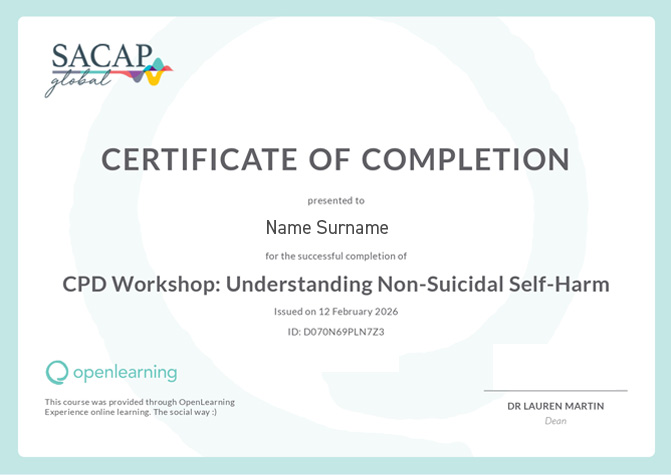
The certificate serves as evidence of your new skills and knowledge and can be used to demonstrate your commitment to professional development.
Attend a live online session, or watch the recording, and complete an online reading and assessment.
HPCSA registered professionals will receive 3 CPD points [3 CEU Continuing Education Units points] upon successful completion of the workshop.
Dates and Registration
Class of 2026: on demand
Participants can register at any time and move through the workshop content. Watch the live workshop recording and complete the online journal articles and multiple-choice questionnaire.
NOTE: HPCSA registered professionals who want to claim 3 CPD points [3 CEU Continuing Education Units points] need to complete the online assessment within 5 days after registering.
Workshop Presenter

Anita Kriel is a Clinical Psychologist by profession. She has dual master’s degrees in clinical psychology and research psychology, and has published in local and international journals. Anita spent over 20 years in private practice and, in 2023, took on a full-time position at SACAP as an Educator.
Course highlights

-

Understand non-suicidal self-injury (NSSI) as a self-regulation strategy.
-
Explore practical, trauma-informed assessment and intervention tools.
-
Apply theory to real clinical practice within the South African context.
FAQs
What are the entry requirements?
Anyone 18 years of age or older can sign up for this online workshop. There are no academic entry requirements or conditions.
Who is this workshop for?
This workshop will help you gain a better understanding of non-suicidal self-injury (NSSI).
What is the time commitment?
A total of 2 hours is required to complete the workshop.
What do you need to do the workshop?
- Access to Microsoft Word
- Google Chrome
- Stable internet connection
Is the workshop assessed?
Learners are required to complete an assessment that includes reading a journal article and answering a multiple choice questionnaire.
Is the workshop accredited?
The online workshop is accredited by the Health Professions Council of South Africa (HPCSA).
What is self-harm?
Self-harm is also known as non-suicidal self-injury disorder. Often, it’s just called self-injury. Self-harm is the act of purposely injuring one’s body as an attempt to cope with emotional pain, for example sadness, anger and stress. Read more here.
What can you do after completing this workshop?
HPCSA registered professionals will receive 3 CPD points [3 CEU Continuing Education Units points] once they complete the workshop.
The Team
The SACAP Global team brings a wealth of knowledge and practical experience across various disciplines. Our expert short course developers and dedicated support team are passionate about sharing their insights to help you get the most out of your online learning journey.



















Related Courses


Holistic Approach to Managing Depression
Explore the intricate landscape of depression and learn how to effectively address and manage depression.


Managing & Preventing Anxiety
Build practical tools and knowledge to effectively address and manage anxiety.

Youth Mental Health First Aid
Explore mental health and gain specific knowledge in suicide and self-harming behaviour in youth.

Symptoms of Crisis & Trauma
Explore immediate and long-term effects of crisis and trauma and accompanying emotional and physical reactions.
$28
Start Date
2 April 2026End Date
31 December 2026-
 Register now. Pay later. 0% Interest.Split into interest free payments.
 -
 Scan to pay.Scan the QR code to pay.
 -

 Credit and debit card.Pay using your credit or debit card.
 -
 Visa Click to Pay.Pay with credit, debit or prepaid card.