
 Purchase this course and get



Structure
Set start and end date
Duration
12 weeks
Commitment
6 hours weekly study
Total Hours
72 hours
Start Date
1 April 2027End Date
27 June 2027
Mode
Online weekly classesCourse Overview
Coaching is one of the most valuable skills a leader can possess. It strengthens relationships, builds trust, and empowers individuals to take ownership of their growth and performance. When managers are confident in how they coach, they create environments where people feel supported, motivated, and capable of achieving more.
Throughout our 12-week leadership and management short course, you will be introduced to practical coaching techniques, grounded in core psychological principles that explore human behaviour and motivation. You’ll develop core competencies that are recognised by the International Coaching Federation (ICF) and be given the opportunity to practice applying these principles directly in your workplace.
The Coaching Skills for Managers online short course is internationally accredited and structured in a work-friendly way, so learners only need to dedicate 6 hours a week to complete it.
Click here to download the course brochure.
What You'll Learn
Week 1: Introduction
• The different types of coaching
• Understand the evolution of coaching
• Unpack the qualities of a coach
Week 2: Change Principles
• Explore some key concepts from positive psychology to frame a coaching approach
• Learn about the importance of coaching conversations
Week 3: Coaching Skills Introduction Session
• Gain an understanding of the range of coaching competencies as delineated by the International Coaching Federation (ICF).
• Explore the GROW model
Week 4: Demonstrating Ethical Practices & Embodying a Coaching Mindset
• Gain the ability to follow applicable ICF guidelines in a management/leadership context
• Recognise the importance of following applicable ICF guidelines and code of ethics.
Week 5: Co-creating the Relationship Part 1: Establishing and Maintaining Agreement, Cultivates Trust & Safety and Maintains Coaching Presence
• Focus on why coaching agreements are used to facilitate a coaching relationship between a coachee and sponsor.
Week 6: Co-creating the Relationship Part 2: Establishing and Maintaining Agreements, Cultivates Trust & Safety, and Maintains Coaching Presence
• Learn how to cultivate trust and safety through clearing coaching agreements.
Week 7: Communicate Effectively: Listening Actively and Evoking Awareness
• Explore the difference between tone of voice and other non-verbal cues.
• Learn how to ask powerful questions to evoke awareness for coaches.
• Discover the usage of metaphors and analogies to inspire or prompt action.
Week 8: Cultivating Learning and Growth
• Understand how internal and interpersonal influences can affect the behaviour and/or performance of a coachee.
Week 9: Coaching Conversation Practice and Feedback
• Learn how to conduct a progress-oriented coaching conversation.
Week 10: Observed Session Reflection: Group Reflection & Feedforward Session
• Participate in facilitated group discussion with an ICF Mentor Coach, including reflection and Q&A on the effective demonstration of ICF competencies.
• Identify 1-3 key developmental edges and create a practical action plan to apply these within peer sessions and real work conversations.
Week 11: Working with Individuals in the context of Teams
• Gain an overview of the similarities and differences between individual and team coaching conversations.
• Revisit the ICF individual and team coaching core competencies and how they are used to cultivate team-based learning and group development.
Week 12: Wrap Up
• Reflect on the learning journey, coaching training experience and feedforward session based on observed sessions.
• Complete competency self-evaluation based on the improvement given in the first and second coaching observation sessions.
• Design a coaching roadmap.
Accreditation
Earn 30 of International Coaching Federation (ICF) education hours, which will count towards the minimum number of coach education hours required to qualify as an Associate Certified Coach with ICF if a trainee wants to be credentialed by the global body.

Course Outcomes
By the end of this course, you will be able to implement coaching conversations which evoke awareness within your workplace. Learn how to empower others to maximise their work-related potential, performance and growth.
- Gain Knowledge
- Experience the core coaching competencies as defined by the International Coaching Federation (ICF).
- Understand Coaching Models
- Learn how to apply the skills you acquired in conversations with colleagues and team members in the workplace.
- Practical Application
- Introduction to basic psychological principles which will enhance your understanding of human behaviour and what motivates people.
- Customised Feedback
- The opportunity to engage with an internationally accredited International Coaching Federation (ICF) coach in a group mentoring session after your practice coaching session.
Learner Experience


Palesa Choane


Kashma Raju


Nobuhle Mahoko

Siphokuhle Dludla

Olwethu Mdoda

Nicolette Morkel

Lerato Thipe

Ronnie Muhl

Rodrique George

Patricia Lenaghan
Certification
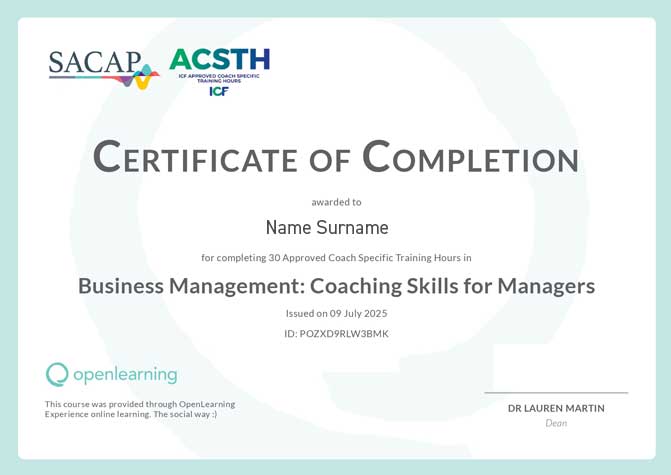
Upon completion, you will receive a digital certificate of completion as evidence of the skills and knowledge demonstrated.
Dates and Registration
- Class of 2027 April: 1 April – 27 June
- Class of 2027 August: 3 August – 31 October
Learners are required to attend weekly online interactive classes as the short course is delivered online by a management expert. Download the April 2027 course schedule or the August 2027 course schedule.
Educators

Nicky Wilson-Harris
Nicky Wilson-Harris is a Master Practitioner in leadership development with experience across corporate, government, and NGO sectors. Her work is grounded in extensive training in coaching and facilitation, supported by local and international credentials. She is a Certified Integral® and Ontological Coach and holds the Master Certified Coach (MCC) credential with the ICF.
In addition, she is a Master Coach Practitioner with COMENSA, as well as an ICF assessor and mentor coach. Furthermore, Nicky has been a Faculty Member at SACAP for over ten years. During this time, she created the introduction to coaching module offered within the Industrial Psychology degree and contributed to the design and delivery of the online coaching programme.

Linda Aiyer
Linda Aiyer is a Global Leadership Coach and Facilitator with 14 years of experience and over 8,500 coaching hours. She works internationally with leaders, executives, and teams across a wide range of industries and regions. Her specialisations include executive coaching, leadership development, and team performance coaching.
In addition, she brings over 15 years of senior corporate management experience in strategy, finance, risk, and IT. Furthermore, Linda serves as an educator, mentor, and assessor in two international coaching institutions. She holds an MBA and the Master Certified Coach (MCC) credential, along with the ICF Advanced Certification in Team Coaching.
Course highlights

-

Get the best from individuals.
-
Empower teams to be engaged and productive.
-
Gain an introduction to coaching as a potential career.
FAQs
What are the entry requirements?
Anyone 18 years of age or older can sign up for this short course. There are no academic entry requirements or conditions.
Who is this short course for?
The Coaching Skills for Managers short course is designed for managers, team leaders, supervisors, and working professionals across corporate organisations, NGOs, government departments, and small to medium-sized businesses. It’s ideal for anyone looking to strengthen their leadership capabilities and integrate effective coaching conversations into their management approach.
What is the time commitment?
- A total of 72 hours is required to complete the short course.
- An average of 6 hours weekly.
- 2 hours for attending an online webinar
- 2 – 3 hours for pre-reading and class preparation
- 1 hour for the weekly multiple-choice quiz
What do you need to do the short course?
- Current or intended supervision, management or leadership of others at work.
- Access to Microsoft Word
- Adobe PDF Converter
- Zoom Video Communications
- Google Chrome (recommended)
- Stable internet
- Textbook not incl. in course fee:
- An introduction to coaching skills: A practical guide (3rd ed.) Van Nieuwerburgh, C. (2020)
Is the short course accredited?
The short course is accredited by the International Coaching Federation (ICF) and carries 30 education hours. These hours can count towards the minimum number coach education hours required to qualify as a Associate Certified Coach with ICF if a trainee wants to be credentialed by the global body.
What coaching is and why it matters in leadership?
Coaching is a collaborative and forward-focused process that helps individuals and teams gain insight, navigate challenges, and pursue meaningful personal and professional growth. It encourages the development of essential abilities such as communication, self-management, critical thinking, and leadership, all of which contribute to stronger team dynamics. In a management context, when leaders can apply coaching skills effectively, they create an environment where people feel supported, empowered, and motivated to take ownership of their work. This approach not only enhances individual confidence and capability but also drives overall organisational performance. Read more on the topic here and here.
What can you do after completing this short course?
This course is a subset of SACAP’s Postgraduate Diploma in Coaching: ICF Level 02 programme, and carries 30 ICF hours and counts towards hours of coach education needed for a portfolio path application if you wish to pursue credentialing with ICF as an Associate Certified Coach.
The Team
The SACAP Global team brings a wealth of knowledge and practical experience across various disciplines. Our expert short course developers and dedicated support team are passionate about sharing their insights to help you get the most out of your online learning journey.



















Related Courses


Intro to Coaching
Explore key aspects of coaching and how it can support personal and professional development.


Intro to Management & Leadership
Acquire practical skills to successfully grow a business and its people. Learn when to manage and when to lead.

Organisation Development: Processes & Tools for Effectiveness
Empower yourself with the knowledge and tools to drive meaningful and sustainable organisational change.

Intro to Organisation Development: Theory & Practice
Learn how to drive organisational change by aligning strategy, structure, people, and processes.

Recruiting & Retaining Top Talent
Explore the practices of employee recruitment, performance management and compensation planning.

Business Management: Global Trends & Organisational Functions
Examine the complex environments influencing business and learn to navigate them effectively as a manager.
$1,052
Start Date
1 April 2027End Date
27 June 2027-
 Register now. Pay later. 0% Interest.Split into interest free payments.
 -
 Scan to pay.Scan the QR code to pay.
 -

 Credit and debit card.Pay using your credit or debit card.
 -
 Visa Click to Pay.Pay with credit, debit or prepaid card.