
Managing & Preventing Anxiety
Build practical tools and knowledge to effectively address and manage anxiety.
$224
 Purchase this course and get



Structure
On-demand
Duration
50 hours
Total Hours
50 hours
Start Date
1 October 2026End Date
31 December 2026
Mode
Self-paced learningCourse Overview
Anxiety is an emotion characterised by intense feelings of worry and fear. Build practical tools and knowledge to address and manage anxiety effectively.
Throughout the Managing & Preventing Anxiety short course, learners will explore anxiety in its many forms, including its manifestations, symptoms, preventive measures and management strategies.
Over the duration of this 50-hour course, you will develop a deep understanding of the psychological, emotional and physiological aspects of anxiety, as well as the social and cultural influences that shape its development and impact.
Ultimately, the course aims to empower learners with a holistic approach to understanding and managing anxiety. By emphasising self-awareness, compassion, and evidence-based practices, it supports mental well-being and long-term resilience.
What You’ll Learn
Through videos, readings and discussions, you will explore the following topics:
Introduction to anxiety
• Start by exploring the multifaceted nature of anxiety and its impact on emotional and psychological well-being.
• Gain insights into the definition of anxiety, recognising it as a complex emotional and psychological state.
• Identify and examine common symptoms to understand how anxiety manifests through emotional, cognitive, and physiological indicators.
• Investigate the neurobiology of anxiety, expanding your knowledge of brain mechanisms and physiological responses linked to anxious states.
• Deepen your understanding of anxiety as a clinical condition through insights from the Diagnostic and Statistical Manual of Mental Disorders (DSM).
• Engage in an experiential anxiety test as a practical opportunity for self-assessment and to strengthen your personal understanding of anxiety’s potential manifestations.
When anxiety becomes a disorder
• Next, analyse the multifaceted nature of anxiety and its progression from normal responses to clinical disorders.
• Explore the biological, psychological, environmental, and genetic factors contributing to anxiety’s complex origins.
• Gain insights into the neurobiology of anxiety and the mechanisms behind emotional and physiological responses.
• Investigate cultural influences and key risk factors such as age, gender, socioeconomic status, and coexisting conditions.
• Understand the role of healthcare professionals in diagnosis and the importance of accurate recognition and intervention.
Holistic anxiety management
• Finally, investigate a diverse range of evidence-based approaches to anxiety management, including mindfulness, relaxation techniques, and cognitive-behavioural strategies.
• Examine the role and effectiveness of therapies such as Cognitive-Behavioural Therapy (CBT) and Exposure Therapy in reducing anxiety.
• Navigate the landscape of medication and pharmacological interventions, gaining insights into their benefits and limitations.
• Expand your perspective with holistic practices such as Pilates, meditation, and alternative therapies for integrated anxiety care.
Course Outcomes
By the end of this course you will be able to:
- Define anxiety and identify the common symptoms.
- Describe the Neurobiology of Anxiety: including brain mechanisms and physiological responses involved in anxiety.
- Consider anxiety through the lens of the The Diagnostic and Statistical Manual of Mental Disorders (DSM).
- Describe the different types of anxiety.
- Analyse your own experience of anxiety by taking the anxiety test.
- Explain how anxiety becomes a disorder.
- Identify the various root causes that trigger anxiety: Biological, Psychological, Environmental factors, and Genetics and Family History.
- Differentiate Normal Anxiety from Anxiety Disorders.
- Identify the Role of Healthcare Providers in Diagnosis.
- Express a deep understanding of the need of a Comprehensive Approach to Anxiety Management.
- Explore mindfulness, relaxation exercises, and cognitive-behavioural strategies for stress reduction.
- Understand Cognitive-Behavioral Therapy (CBT), Exposure Therapy, and The Floating Technique.
- Explore the use of medication in treating anxiety disorders and understand their benefits and limitations.
- Integrate holistic practices such as meditation and alternative therapies in the management of anxiety.
Learner Experience


Kayla Thomsen


Alexandra Dames


Cherise Steenberg

Ntswaki Manye

Wulganithi Thaver

Claudette Timmer

Elizabeth Lizna Lucas
Chaya Meryl Smith
Certification
Upon completion, you will receive a digital certificate of completion as evidence of the skills and knowledge demonstrated.
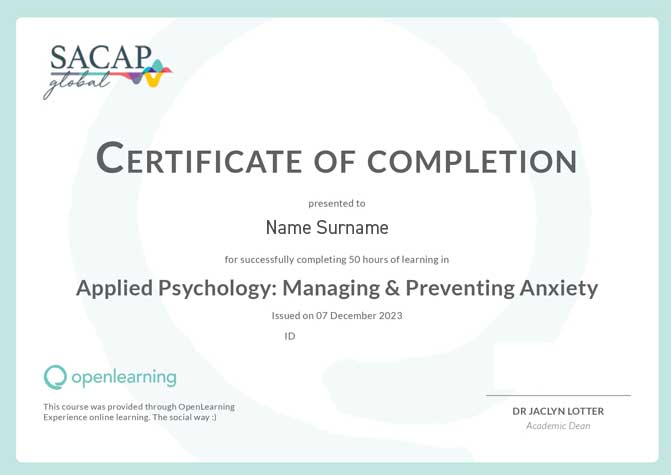
The Managing & Preventing Anxiety short course has been designed and developed by experts in the field of psychology. The course is for anyone needing to upskill in this area and offers 50 hours of learning.
Dates and Registration
- Class of 2026 Oct-Dec: 1 October – 31 December
- Class of 2027 Jan-Mar: 1 January – 31 March
Short course classes are on demand allowing you to register at any time and move through course content at a time that suits you. Learners will have access to the course for the class period they choose when registering.
Course highlights

-

Examine the psychological, emotional, and physiological dimensions of anxiety.
-
Gain a holistic perspective on the symptoms, preventive measures and effective management strategies for anxiety.
-
Build practical tools to better manage anxiety.
FAQs
What are the entry requirements?
Anyone 18 years of age or older can sign up for this short course. There are no academic entry requirements or conditions.
Who is this short course for?
This short course is for anyone wanting a comprehensive understanding of anxiety, from its various manifestations and symptoms to preventive measures and management strategies.
What is the time commitment?
A total of 50 hours is required to complete the short course.
What do you need to do the short course?
- Access to Microsoft Word
- Google Chrome (recommended)
- Stable internet connection
Is the short course accredited?
The short course is not accredited and non-credit bearing.
What is anxiety?
Anxiety is a feeling of fear, worry, dread, and uneasiness. “Normal” anxiety is short-term and related to a stressor. When anxiety is persistent and impacts one’s functioning, it needs attention to manage and minimise its impact in your life. Read more here.
The Team
The SACAP Global team brings a wealth of knowledge and practical experience across various disciplines. Our expert short course developers and dedicated support team are passionate about sharing their insights to help you get the most out of your online learning journey.



















Related Courses


Stress Management & Building Resilience
Understand stress responses and triggers and build practical techniques to manage stress and burnout.


Introducing the EmotionAid® Protocol
Learn how to manage stress and trauma using the 5-step EmotionAid® Protocol.

Understanding Burnout Through the Lens of Compassion
Understand how burnout differs from stress and build practical skills to protect, prevent and manage burnout.

Positive Psychology: The Science of Happiness
Build practical tools to boost your own happiness and support those around you in doing the same.
$224
Start Date
1 October 2026End Date
31 December 2026-
 Register now. Pay later. 0% Interest.Split into interest free payments.
 -
 Scan to pay.Scan the QR code to pay.
 -

 Credit and debit card.Pay using your credit or debit card.
 -
 Visa Click to Pay.Pay with credit, debit or prepaid card.