CloseClose Modal

You're almost done!

Remember to navigate back to the website after you've completed the payment. This is the last step to ensure you're successfully registered for your course.

CloseClose Modal

Confirm your email address

Please confirm your email address by typing it in the Confirm email address field.

CloseClose Modal

Thanks for subscribing!

Keep an eye on your inbox as we'll be sharing weekly updates on new courses, discounts and giveaways.

CloseClose Modal

Thanks for subscribing!

Keep an eye on your inbox as we'll be sharing weekly updates on discounts, promotions and giveaways.

Close Close Modal

Thank you for your enquiry!

We've received your request. A member of our team will be in touch soon with more information about the course.

In the meantime, feel free to explore more of our courses.

Explore our NEW CPD Workshops and upskill in 3 hours or less.

REGISTER NOW
  • Areas of Expertise
  • Full Qualifications
  • Blogs
  • FAQ
  • Gift Voucher
Search
Choose currency
SA flag
R - ZAR
SA flag
R - ZAR
USA flag
$ - USD
  • Browse Courses
    • Applied Psychology icon Applied Psychology dark icon Applied Psychology
    • Counselling icon Counselling dark icon Counselling
    • Business Management & Coaching  icon Business Management & Coaching  dark icon Business Management & Coaching 
    • HR & People Management icon HR & People Management dark icon HR & People Management
    • Communication icon Communication dark icon Communication
    • Everyday Psychology icon Everyday Psychology dark icon Everyday Psychology
    • Future Skills icon Future Skills
    • View All
    • Psychological Theories of Child & Adolescent Development
    • Counselling Children & Youth
    • Factors Influencing Human Behaviour
    • Intro to Human Behaviour
    • Domains of Psychology
    • Sports Psychology
    • VIEW ALL (24)
    • Counselling Children & Youth
    • Fundamental Counselling Skills
    • Deepening Your Counselling Skills
    • Intro to Couple Counselling
    • Clinical Observation in Therapeutic Practice: Through the Lens of Jungian Sandplay
    • VIEW ALL (5)
    • Coaching Conversations to Evoke Awareness: Beyond Habitual Questioning
    • Intro to Management & Leadership
    • Coaching Skills for Managers
    • Intro to Consumer Behaviour & Psychology
    • Essential Entrepreneurial Skills
    • Intro to Coaching
    • VIEW ALL (6)
      • Building Strong Relationships
      • How to Have Critical Conversations
      • Clinical Observation in Therapeutic Practice: Through the Lens of Jungian Sandplay
      • VIEW ALL (3)
      • Creative Thinking & Problem Solving
      • Stress Management & Building Resilience
      • Developing Holistic Intelligence: EQ & Beyond
      • Positive Psychology: The Science of Happiness
      • VIEW ALL (4)
      • AI in Education: Ethics & Innovation
      • Intro to Excel: Data Analysis & Visualisation
      • Using AI Tools in Everyday Life
      • Navigating the Impact of AI in the Field of Mental Health
      • VIEW ALL (4)
      • Applied Psychology icon Applied Psychology
        • Psychological Theories of Child & Adolescent Development
        • Counselling Children & Youth
        • Factors Influencing Human Behaviour
        • Intro to Human Behaviour
        • Domains of Psychology
        • Sports Psychology
        • Developing a Growth Mindset
        • Managing & Preventing Anxiety
        • VIEW ALL (24)
      • Counselling icon Counselling
        • Counselling Children & Youth
        • Fundamental Counselling Skills
        • Deepening Your Counselling Skills
        • Intro to Couple Counselling
        • Clinical Observation in Therapeutic Practice: Through the Lens of Jungian Sandplay
        • VIEW ALL (5)
      • Business Management & Coaching  icon Business Management & Coaching 
        • Coaching Conversations to Evoke Awareness: Beyond Habitual Questioning
        • Intro to Management & Leadership
        • Coaching Skills for Managers
        • Intro to Consumer Behaviour & Psychology
        • Essential Entrepreneurial Skills
        • Intro to Coaching
        • VIEW ALL (6)
      • HR & People Management icon HR & People Management
      • Communication icon Communication
        • Building Strong Relationships
        • How to Have Critical Conversations
        • Clinical Observation in Therapeutic Practice: Through the Lens of Jungian Sandplay
        • VIEW ALL (3)
      • Everyday Psychology icon Everyday Psychology
        • Creative Thinking & Problem Solving
        • Stress Management & Building Resilience
        • Developing Holistic Intelligence: EQ & Beyond
        • Positive Psychology: The Science of Happiness
        • VIEW ALL (4)
      • Future Skills icon Future Skills
        • AI in Education: Ethics & Innovation
        • Intro to Excel: Data Analysis & Visualisation
        • Using AI Tools in Everyday Life
        • Navigating the Impact of AI in the Field of Mental Health
        • VIEW ALL (4)
      • View All Courses
    • Promotions
    • About Us
    • My Account
    • My Account
    • Areas of Expertise
    • FAQ
    • Study in South Africa
    • Blogs
    • Choose currency
      SA flag
      R - ZAR
      SA flag
      R - ZAR
      USA flag
      $ - USD
    Applied Psychology

    Understanding Non-Suicidal Self-Harm

    Explore non-suicidal self-injury as a self-regulation strategy and gain practical, trauma-informed tools for assessment and intervention.

    R460.00

    Purchase this course and get 18 Loyalty Points
    Purchase this course and get 18 Loyalty Points
    
		selfharm
    Structure
    Anytime registration
    Availability
    Complete your course within 5 days
    Duration
    3 hours
    Total Hours
    3 hours
    Start Date
    2 April 2026
    End Date
    31 December 2026
    Mode
    Mode
    Self-paced learning
    • Introduction
    • Overview
    • Outcomes
    • Testimonials
    • Certification
    • Dates
    • Presenter
    • Highlights
    • FAQs
    • The Team

    Workshop Introduction

    Self-harm, also known as non-suicidal self-injury (NSSI), is the deliberate act of injuring one’s body, often as a way to cope with intense emotional pain such as sadness, anger, or stress. Self-harm is a sign of underlying emotional distress or an associated mental health condition.

    The Understanding Non-Suicidal Self-Harm workshop offers mental health professionals a practical, trauma-informed approach to understanding and treating self-harm.

    The workshop covers the DSM-5-TR, neurobiology, and a self-regulation model and looks at why individuals engage in non-suicidal self-injury (NSSI) and how to clearly distinguish it from suicidal behaviour.

    Participants will learn how to conduct assessments, create trauma-informed case formulations, and use intervention strategies in their clinical work.

    The workshop ends by looking into risk management, ethical aspects, and socio-cultural factors relevant to NSSI in the South African context. It equips mental health practitioners with tools they can apply right away in therapy.

    Overview

    • Understanding non-suicidal self-injury (NSSI)
    • Non-suicidal self-injury (NSSI) in the DSM-5 TR
    • Non-suicidal self-injury (NSSI) as Self-Regulation
    • Neurological Pathways
    • Demographics & South African Context
    • Assessment & Formulation
    • Intervention Strategies
    • Ethical & Professional Considerations
    • Resources and Key Takeaways

    Learning Outcomes

    By the end of the workshop, participants will be able to:

    • Clearly define non-suicidal self-injury (NSSI).
    • Understand how non-suicidal self-injury (NSSI) is classified in the DSM-5-TR.
    • Conceptualise non-suicidal self-injury (NSSI) through a self-regulation lens.
    • Describe the neurological processes involved in non-suicidal self-injury (NSSI).
    • Recognise how trauma, developmental factors, and socio-cultural influences.
    • Conduct function-focused, trauma-informed assessments and develop clear case formulations.
    • Apply best-practice clinical thinking.
    • Implement practical, evidence-informed intervention strategies in therapeutic settings.
    • Navigate ethical and professional considerations related to non-suicidal self-injury (NSSI).
    • Use practical tools such as the NSSI Regulation Mapping Worksheet to support clinical work.

    Learner Experience

    Ashley Motene

    Ashley Motene

    "I found the workshop incredibly insightful and grounding. It helped me better understand the “why” behind self-harm and gave me practical ways to respond with more empathy and confidence. The space felt safe and engaging, and I left feeling both challenged and supported in my learning."
    Tara Schmidt

    Tara Schmidt

    "The workshop was very informative. I found the speaker easy to follow and the content was interesting. I particularly enjoyed the practical application."
    Zeldine Russell

    Zeldine Russell

    "One of my most impactful learning experience was engaging in material that requires critical thinking and it taught me to view information from different angles to fully understand complex topics in psychology."
    Kian Wright

    Kian Wright

    "The online workshop that I attended was very informative. I would definetly say that it provided a lot of clarity around the topic of NSSI."

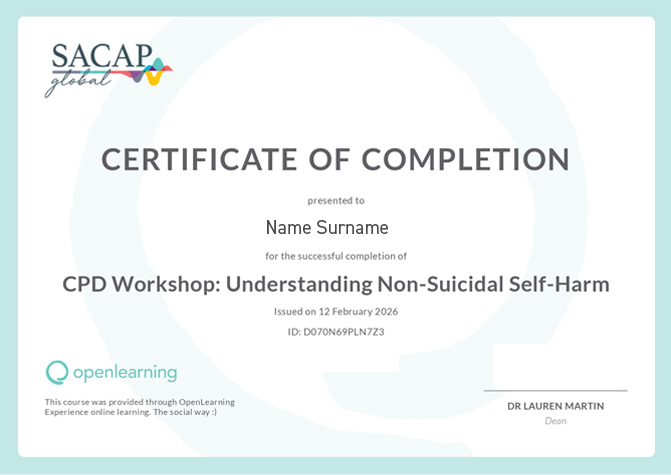
    Certification

    This CPD workshop has been designed for psychologists, mental health practitioners and anyone interested in gaining knowledge in non-suicidal self-injury (NSSI).

    The certificate serves as evidence of your new skills and knowledge and can be used to demonstrate your commitment to professional development. 

    Attend a live online session, or watch the recording, and complete an online reading and assessment. 

    HPCSA registered professionals will receive 3 CPD points [3 CEU Continuing Education Units points] upon successful completion of the workshop.

    Dates and Registration

    Class of 2026: on demand

    Participants can register at any time and move through the workshop content. Watch the live workshop recording and complete the online journal articles and multiple-choice questionnaire.

    NOTE: HPCSA registered professionals who want to claim 3 CPD points [3 CEU Continuing Education Units points] need to complete the online assessment within 5 days after registering.

    Workshop Presenter

    Anita Kriel is a Clinical Psychologist by profession. She has dual master’s degrees in clinical psychology and research psychology, and has published in local and international journals. Anita spent over 20 years in private practice and, in 2023, took on a full-time position at SACAP as an Educator.

    Course highlights

    Self-harm image of girl in dark room
    • Understand non-suicidal self-injury (NSSI) as a self-regulation strategy.

    • Explore practical, trauma-informed assessment and intervention tools.

    • Apply theory to real clinical practice within the South African context.

    FAQs

    What are the entry requirements?

    Anyone 18 years of age or older can sign up for this online workshop. There are no academic entry requirements or conditions.

    Who is this workshop for?

    This workshop will help you gain a better understanding of non-suicidal self-injury (NSSI).

    What is the time commitment?

    A total of 2 hours is required to complete the workshop. 

    What do you need to do the workshop?
    • Access to Microsoft Word
    • Google Chrome
    • Stable internet connection

    Is the workshop assessed?

    Learners are required to complete an assessment that includes reading a journal article and answering a multiple choice questionnaire.

    Is the workshop accredited?

    The online workshop is accredited by the Health Professions Council of South Africa (HPCSA). 

    What is self-harm? 

    Self-harm is also known as non-suicidal self-injury disorder. Often, it’s just called self-injury. Self-harm is the act of purposely injuring one’s body as an attempt to cope with emotional pain, for example sadness, anger and stress. Read more here.

    What can you do after completing this workshop?

    HPCSA registered professionals will receive 3 CPD points [3 CEU Continuing Education Units points] once they complete the workshop.

    The Team

    The SACAP Global team brings a wealth of knowledge and practical experience across various disciplines. Our expert short course developers and dedicated support team are passionate about sharing their insights to help you get the most out of your online learning journey.

    Gert Lamprecht
    Shanice Thusi
    Crystal-Shimirhi Bezuidenhoud
    Wanga Nemavhola
    Kiara Parsuram
    Tarien Theron
    Carl Badenhorst
    Nadia Janssen
    Kaylynn Philander
    Siphesihle Zamane
    Stephenie Ramphul
    Otto Uys
    Ilze Martin
    Karolyne Williams
    Charlotte Heyn
    Laura Neal

    Related Courses

    Start now
    Short course

    Holistic Approach to Managing Depression

    Duration
    50 hours
    Price
    R3,700.00
    Start Date
    Anytime

    Explore the intricate landscape of depression and learn how to effectively address and manage depression.

    View course
    Add to Cart More Info Class of 2026 Oct-Dec
    Start now
    Short course

    Managing & Preventing Anxiety

    Duration
    50 hours
    Price
    R3,700.00
    Start Date
    Anytime

    Build practical tools and knowledge to effectively address and manage anxiety.    

    View course
    Add to Cart More Info Class of 2026 Oct-Dec
    Start Now
    CPD workshop

    Youth Mental Health First Aid

    Duration
    3 hours
    Price
    R460.00
    Start Date
    Anytime

    Explore mental health and gain specific knowledge in suicide and self-harming behaviour in youth.

    View course
    Add to Cart More Info Class of 2026
    Coming Soon
    Micro-credential

    Symptoms of Crisis & Trauma

    Duration
    2 weeks
    Price
    TBC
    Start Date
    TBC

    Explore immediate and long-term effects of crisis and trauma and accompanying emotional and physical reactions.

    View course
    Coming Soon

    R460.00

    or R115 x 4 via PayFlex.
    Start Date
    Anytime
    End Date
    31 December 2026
    Purchase this course and get 18 Loyalty Points
    Purchase this course and get 18 Loyalty Points
    Get More Information
    • Register now, pay later with 0% interest via PayFlex
      Register now. Pay later. 0% Interest.
      Split into interest free payments.
    • Scan to pay
      Scan to pay.
      Scan the QR code to pay.
    • Credit and debit card Credit and debit card
      Credit and debit card.
      Pay using your credit or debit card.
    • Visa Click to Pay
      Visa Click to Pay.
      Pay with credit, debit or prepaid card.

    Resources
    • FAQs
    • Browse Courses
    • Terms and Conditions
    • Payflex
    SACAP Global
    • Areas of Expertise
    • Contact Us
    • About Us
    • About SACAP
    VisaMastercardMobicredPayflexSnapScanZapperSamsung PayApple Pay

    Copyright © 2026 South African College of Applied Psychology. All Rights Reserved.

    Terms and ConditionsPrivacy Policy

    • This field is for validation purposes and should be left unchanged.
    • Subscribe

      Join our community and get 20% off on your first online course

    • By supplying your contact details, you consent to receive communications from SACAP Global and SACAP related to your course of interest and similar topics. You agree to the use of your data as described in our privacy policy and you may opt out of receiving communication at any time.

    We use cookies to ensure you get the best possible experience, but please feel free to review our privacy policy or manage your consent.
    Cookie Settings

    Accept
    Manage consent

    Privacy Overview

    This website uses cookies to improve your experience while you navigate through the website. Out of these, the cookies that are categorized as necessary are stored on your browser as they are essential for the working of basic functionalities of the website. We also use third-party cookies that help us analyze and understand how you use this website. These cookies will be stored in your browser only with your consent. You also have the option to opt-out of these cookies. But opting out of some of these cookies may affect your browsing experience.
    Necessary
    Always Enabled
    Necessary cookies are absolutely essential for the website to function properly. These cookies ensure basic functionalities and security features of the website, anonymously.
    SAVE & ACCEPT
    Loading...